Skip to Content Skip to Footer
Oklahoma WIC logo
Home
The Live Well logo features a modern design promoting a healthy, balanced lifestyle
Search
  • Español
  • Ellyn Satter
    • Ellyn Satter
      Prenatal / Postpartum
    • Ellyn Satter
      Newborn / Infant
    • Ellyn Satter
      Older Baby / Almost Toddler
    • Ellyn Satter
      Toddler / Preschooler
  • Breastfeeding
  • Eat·Grow·Live Healthy
    • Eat·Grow·Live Healthy
      Women
    • Eat·Grow·Live Healthy
      Infants
    • Eat·Grow·Live Healthy
      Children
    • Eat·Grow·Live Healthy
      Fathers
  • Live Well Blog
  • Videos
  • Approved Food List
    • Approved Food List
      Cherokee Nation
    • Approved Food List
      Chickasaw Nation
    • Approved Food List
      Choctaw Nation
    • Approved Food List
      ITCO
    • Approved Food List
      Oklahoma
    • Approved Food List
      Osage Nation
    • Approved Food List
      WCD

Nursing Strike

  • Home
  • Breastfeeding
  • Common Challenges & Solutions
  • Nursing Strike

Nursing Strike

A nursing “strike” is when your baby has breastfed well for months then suddenly begins to refuse the breast. This is usually temporary and typically does not mean your baby is ready to wean.

A nursing strike can mean your baby is trying to let you know something is wrong. All babies are different and will not react the same way. Some babies will continue to breastfeed without a problem. Other babies may just become fussy at the breast. And other babies will refuse the breast entirely.

Some causes of a nursing strike include:

  • Having mouth pain from teething, a fungal infection like thrush, or a cold sore.
  • Having an ear infection, which causes pain while sucking or pressure while lying on one side.
  • Feeling pain from a certain breastfeeding position, perhaps from an injury on the baby’s body or from soreness from an immunization.
  • Being upset about a long separation from the breastfeeding mother or a major change in routine.
  • Being distracted while breastfeeding, such as becoming interested in other things going on around them.
  • Having a cold or stuffy nose that makes it hard to breathe while breastfeeding.
  • Getting less milk from the breastfeeding mother after supplementing human milk with bottles or overuse of a pacifier.
  • Responding to the mother’s strong reaction if the baby has bitten her while breastfeeding.
  • Reacting to changes in soap or other cosmetics that might smell unfamiliar.
  • Responding to changes in the taste of milk because of an illness, medication, or diet.

If your baby is on a nursing strike, it is normal to feel frustrated and upset, especially if your baby is unhappy. Be patient with your baby and keep trying to offer your breasts.

What you can do:

  • Try to express your milk as often as the baby used to breastfeed to avoid engorgement and plugged ducts.
  • Try another feeding method temporarily to give your baby human milk, such as using a cup, dropper, or spoon.
  • Keep track of your baby’s wet and dirty diapers to make sure they get enough milk.
  • Keep offering your breast to your baby. If your baby is frustrated, stop, and try again later. You can also offer your breast when your baby is very sleepy or is sleeping.
  • Try different breastfeeding positions, with your bare skin next to your baby’s bare skin.
  • Focus on and comfort your baby with extra touching and cuddling.
  • Breastfeed your baby in a quiet room with few distractions.

If you are worried your baby is not getting enough milk, talk to their healthcare provider. They can check your baby’s weight gain.

You May Also Like...

Inverted, Flat, or Very Large Nipples

Inverted, Flat, or Very Large Nipples Share to social Share Inverted, Flat, or Very Large Nipples Some women have nipples that turn inward instead of pointing outward or are flat…

Read More

Jaundice

Jaundice Share to social Share Jaundice Jaundice is caused by too much bilirubin. Bilirubin is a yellow-colored substance in the blood. If your baby has jaundice, you may notice their…

Read More

Reflux Disease (or GERD)

Reflux Disease (or GERD) Share to social Share Reflux Disease (or GERD) Some babies have a condition called gastroesophageal reflux disease (GERD). GERD happens when the stomach muscle opens at…

Read More
Oklahoma Wic Logo
  • Contact Us

USDA is an equal opportunity provider, employer, and lender.

Cookie PolicyPrivacy Policy

© Brush Art Corporation

  • Email
  • SMS
If you are using multiple emails, separate them with commas.

    Share

    Share this link via:

    Two abstract figures with interlocking hands and circles.

    HAND EXPRESSION

    How it works

    Use your hand to gently massage and compress your breast to remove milk.

    What’s Involved

    • Requires practice, skill, and coordination.
    • Gets easier with practice and can be as fast as pumping.
    • Good if you are not often away from your baby or you need an option that is always with you. All moms should know how to hand express, in case they need to do it unexpectedly.

    Average Cost

    Free

    Illustration of diverse fruits and vegetables forming colorful patterns.

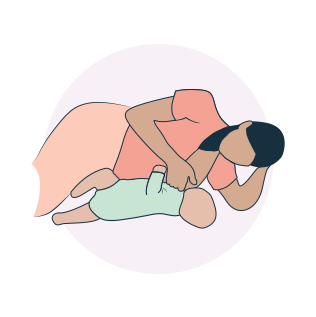
    Side-Lying Hold

    1. For the right breast, lie on your right side with your baby facing you.
    2. Pull your baby close. Your baby’s mouth should be level with your nipple.
    3. In this position, you can cradle your baby’s back with your left arm and support yourself with your right arm and/or pillows.
    4. Keep loose clothing and bedding away from your baby.
    5. Reverse for the left breast.

    This hold is useful when:

    • You had a C-section
    • You want to rest while baby feeds
    • You are breastfeeding in the middle of the night
    • You and your baby are comfortable in this position
    Owl with outstretched wings soaring gracefully in flight.

    Cross-Cradle Hold

    1. For the right breast, use your left arm to hold your baby’s head at your right breast and baby’s body toward your left side. A pillow across your lap can help support your left arm.
    2. Gently place your left hand behind your baby’s ears and neck, with your thumb and index finger behind each ear and your palm between baby’s shoulder blades. Turn your baby’s body toward yours so your tummies are touching.
    3. Hold your breast as if you are squeezing a sandwich. To protect your back, avoid leaning down to your baby. Instead, bring your baby to you.
    4. As your baby’s mouth opens, push gently with your left palm on baby’s head to help them latch on. Make sure you keep your fingers out of the way.
    5. Reverse for the left breast.

    This hold is useful when:

    • Your baby is premature
    • Your baby has a weak suck
    • Your baby needs help to stay latched
    • Your baby needs extra head support
    • You and your baby are comfortable in this position
    "Happy cartoon family holding hands, smiling together."

    Clutch or “Football” Hold

    1. For the right breast, hold your baby level, facing up, at your right side.
    2. Put your baby’s head near your right nipple and support their back and legs under your right arm.
    3. Hold the base of your baby’s head with your right palm. A pillow underneath your right arm can help support your baby’s weight.
    4. To protect your back, avoid leaning down to your baby. Bring baby to you instead.
    5. Reverse for the left breast.

    This hold is useful when:

    • You had a C-section
    • You have large breasts
    • You have flat or inverted nipples
    • You have a strong milk let-down
    • You are breastfeeding twins
    • Your baby likes to feed in an upright position
    • Your baby has reflux
    • You and your baby are comfortable in this position
    Stylized abstract shapes forming an intricate pattern.

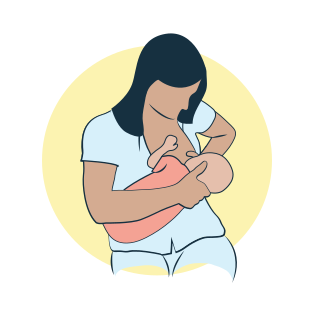
    Cradle Hold

    1. For the right breast, cradle your baby with your right arm. Your baby will be on their left side across your lap, facing you at nipple level.
    2. Your baby’s head will rest on your right forearm with your baby’s back along your inner arm and palm.
    3. Turn your baby’s tummy toward your tummy. Your left hand is free to support your breast, if needed. Pillows can help support your arm and elbow.
    4. To protect your back, avoid leaning down to your baby. Instead, bring your baby to you.
    5. Reverse for the left breast.

    This hold is useful when:

    • Your baby needs help latching on
    • You and your baby are comfortable in this position
    "Abstract pattern of colorful overlapping shapes and circles."

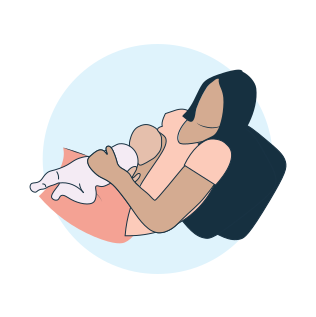
    Laid-Back Hold

    1. Lean back on a pillow with your baby’s tummy touching yours and their head at breast level. Some moms find that sitting up nearly straight works well. Others prefer to lean back and lie almost flat.
    2. You can place your baby’s cheek near your breast, or you may want to use one hand to hold your breast near your baby. It’s up to you and what you think feels best.
    3. Your baby will naturally find your nipple, latch, and begin to suckle.

    This hold is useful when:

    • Your baby is placed on your chest right after birth
    • You have a strong milk let-down
    • You have large breasts
    • You and your baby are comfortable in this position