Skip to Content Skip to Footer
Oklahoma WIC logo
Home
The Live Well logo features a modern design promoting a healthy, balanced lifestyle
Search
  • Español
  • Ellyn Satter
    • Ellyn Satter
      Prenatal / Postpartum
    • Ellyn Satter
      Newborn / Infant
    • Ellyn Satter
      Older Baby / Almost Toddler
    • Ellyn Satter
      Toddler / Preschooler
  • Breastfeeding
  • Eat·Grow·Live Healthy
    • Eat·Grow·Live Healthy
      Women
    • Eat·Grow·Live Healthy
      Infants
    • Eat·Grow·Live Healthy
      Children
    • Eat·Grow·Live Healthy
      Fathers
  • Live Well Blog
  • Videos
  • Approved Food List
    • Approved Food List
      Choctaw Nation
    • Approved Food List
      Chickasaw Nation
    • Approved Food List
      ITCO
    • Approved Food List
      Osage Nation
    • Approved Food List
      WCD
    • Approved Food List
      Approved Food List Oklahoma

Making food easy to eat

  • Home
  • Ellyn Satter
  • Older Baby / Almost Toddler
  • Older Baby / Almost Toddler (9-12 Months)
  • Making food easy to eat
Toddler eating pastry, looking curious and content.

Your child is ready to learn to eat most of the foods you eat.

What meal do you have often?

What meal do you have when you want something special?

How can you make those foods right for your child?

What foods can your child pick up, chew, and swallow?

Here’s how to make food right for your child:

  • Have food that is moist and tender.
  • Cut food into bite-sized pieces to make it easy to pick up, chew, and swallow.
  • Offer cooked vegetables. Offer soft fruits: bananas, orange slices, melon, mangos.
  • Change or don’t give foods that can make him choke. Cut hot dogs the long way. Take out all fish bones. Mash cooked dried beans. Cook carrots.
  • Offer butter, gravy, sauce, or salsa to make food taste good and slide down better.
  • Spicy food is okay if it isn’t too spicy.

What about eating out, ordering in, or having foods from other cultures?

  • Ask parents from other cultures what they feed their young children. Foods that are new to us are every-day foods for those families.
  • Serve him part of a meal. Even if he doesn’t eat stir-fry or quesadilla; he can still enjoy rice or refried beans.
  • Cut pizza into bite-sized pieces. Be careful to cool it down. Cut off the hard crust.
  • Give strips of hamburger or cheeseburger. Give French fries if they aren’t too hard.
  • Cut up fried chicken or chicken nuggets. Take barbeque off the bone and cut it up.
  • Cut up burritos. Cut shredded chicken or beef into short pieces across the grain.

You May Also Like...

How to feed your almost-toddler

How to feed your almost-toddler Share to social Share How is feeding going? What do you like about feeding? What don’t you like? Is there anything you would like to…

Read More

Making your own baby food

Making your own baby food Share to social Share If you cook meals for yourself, it’s simple to make the food right for your baby. If you don’t cook meals…

Read More

Feeding your prematurely born older baby

Feeding your prematurely born older baby Share to social Share How do you feel your baby is coming along? How is he like or not like babies who weren’t born…

Read More

© Ellyn Satter

Oklahoma Wic Logo
  • Contact Us

USDA is an equal opportunity provider, employer, and lender.

Cookie PolicyPrivacy Policy

© Brush Art Corporation

  • Email
  • SMS
If you are using multiple emails, separate them with commas.

    Share

    Share this link via:

    Two abstract figures with interlocking hands and circles.

    HAND EXPRESSION

    How it works

    Use your hand to gently massage and compress your breast to remove milk.

    What’s Involved

    • Requires practice, skill, and coordination.
    • Gets easier with practice and can be as fast as pumping.
    • Good if you are not often away from your baby or you need an option that is always with you. All moms should know how to hand express, in case they need to do it unexpectedly.

    Average Cost

    Free

    Illustration of diverse fruits and vegetables forming colorful patterns.

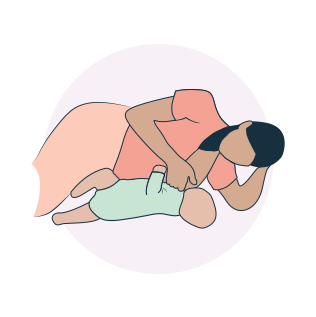
    Side-Lying Hold

    1. For the right breast, lie on your right side with your baby facing you.
    2. Pull your baby close. Your baby’s mouth should be level with your nipple.
    3. In this position, you can cradle your baby’s back with your left arm and support yourself with your right arm and/or pillows.
    4. Keep loose clothing and bedding away from your baby.
    5. Reverse for the left breast.

    This hold is useful when:

    • You had a C-section
    • You want to rest while baby feeds
    • You are breastfeeding in the middle of the night
    • You and your baby are comfortable in this position
    Owl with outstretched wings soaring gracefully in flight.

    Cross-Cradle Hold

    1. For the right breast, use your left arm to hold your baby’s head at your right breast and baby’s body toward your left side. A pillow across your lap can help support your left arm.
    2. Gently place your left hand behind your baby’s ears and neck, with your thumb and index finger behind each ear and your palm between baby’s shoulder blades. Turn your baby’s body toward yours so your tummies are touching.
    3. Hold your breast as if you are squeezing a sandwich. To protect your back, avoid leaning down to your baby. Instead, bring your baby to you.
    4. As your baby’s mouth opens, push gently with your left palm on baby’s head to help them latch on. Make sure you keep your fingers out of the way.
    5. Reverse for the left breast.

    This hold is useful when:

    • Your baby is premature
    • Your baby has a weak suck
    • Your baby needs help to stay latched
    • Your baby needs extra head support
    • You and your baby are comfortable in this position
    "Happy cartoon family holding hands, smiling together."

    Clutch or “Football” Hold

    1. For the right breast, hold your baby level, facing up, at your right side.
    2. Put your baby’s head near your right nipple and support their back and legs under your right arm.
    3. Hold the base of your baby’s head with your right palm. A pillow underneath your right arm can help support your baby’s weight.
    4. To protect your back, avoid leaning down to your baby. Bring baby to you instead.
    5. Reverse for the left breast.

    This hold is useful when:

    • You had a C-section
    • You have large breasts
    • You have flat or inverted nipples
    • You have a strong milk let-down
    • You are breastfeeding twins
    • Your baby likes to feed in an upright position
    • Your baby has reflux
    • You and your baby are comfortable in this position
    Stylized abstract shapes forming an intricate pattern.

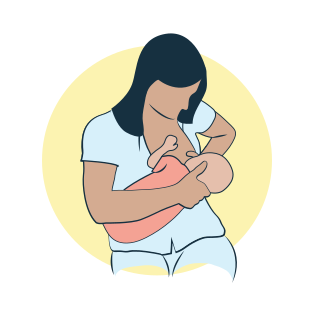
    Cradle Hold

    1. For the right breast, cradle your baby with your right arm. Your baby will be on their left side across your lap, facing you at nipple level.
    2. Your baby’s head will rest on your right forearm with your baby’s back along your inner arm and palm.
    3. Turn your baby’s tummy toward your tummy. Your left hand is free to support your breast, if needed. Pillows can help support your arm and elbow.
    4. To protect your back, avoid leaning down to your baby. Instead, bring your baby to you.
    5. Reverse for the left breast.

    This hold is useful when:

    • Your baby needs help latching on
    • You and your baby are comfortable in this position
    "Abstract pattern of colorful overlapping shapes and circles."

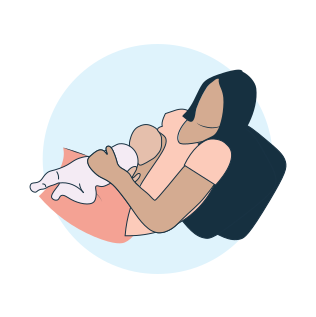
    Laid-Back Hold

    1. Lean back on a pillow with your baby’s tummy touching yours and their head at breast level. Some moms find that sitting up nearly straight works well. Others prefer to lean back and lie almost flat.
    2. You can place your baby’s cheek near your breast, or you may want to use one hand to hold your breast near your baby. It’s up to you and what you think feels best.
    3. Your baby will naturally find your nipple, latch, and begin to suckle.

    This hold is useful when:

    • Your baby is placed on your chest right after birth
    • You have a strong milk let-down
    • You have large breasts
    • You and your baby are comfortable in this position